

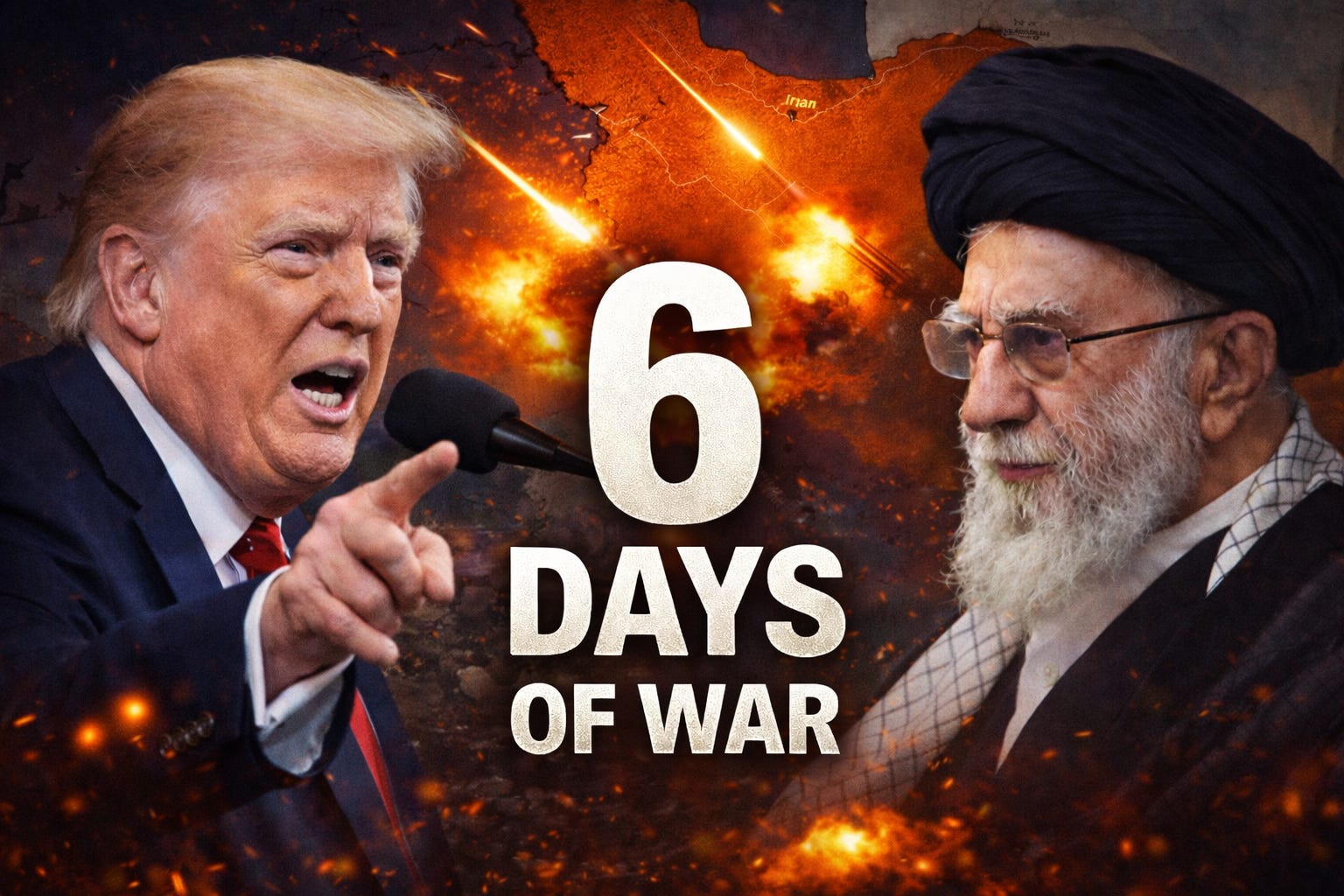
On 28 February 2026 the United States and Israel launched coordinated strikes on Iran. Six days later the conflict is still ongoing, still escalating and still spreading. Here are six things the last six days has confirmed.
1. Regime change is now openly stated American foreign policy
At exactly 2:30am EST on 28 February, Donald Trump released a video statement on Truth Social. In it he stated plainly that the purpose of the strikes on Iran was regime change. He told members of the IRGC to lay down their weapons or face death. He addressed the Iranian public directly and told them to take over their government when it was all over.
There was no pretence. No weapons of mass destruction narrative that took months to build. No resolution passed through the Security Council. No coalition of the willing assembled for the cameras. Just a straightforward declaration that America had decided who should govern Iran and was using its military to make that happen.
For all the talk of international norms, sovereignty and the rules based order, the most powerful nation on earth has stated openly that it will remove the government of another sovereign state by force if it chooses to. And the response from America’s European allies has been to fall in line.
2. The West still deliberately targets children
Within the first 24 hours of strikes on Iran, reports of civilian casualties began to emerge. This is not a surprise to anyone who has watched what happened in Gaza, or in Iraq before that, or in Afghanistan before that.
The pattern is always the same. Strikes are described as precise and targeted. The language used is clinical. Military infrastructure, command centres, strategic assets. And then the images emerge of what those strikes actually hit.
Lebanese health authorities confirmed that those killed in Lebanon in the first 24 hours of the conflict expanding there included seven children. This was not reported as a major story. It was a footnote in the rolling coverage of missile exchanges and interceptor counts.
Abu Bakr Sadiq (ra), the first Caliph of the Muslims, gave the army of Usamah the following instruction before it departed for Syria.
“You shall kill neither a young child nor an old man nor a woman.”
The History of Al Tabari, Volume X, Page 16
This was the standard set over 1400 years ago. The West has not come close to meeting it in any conflict in living memory. The targeting of civilian areas is not a failure of precision, it is a deliberate tactic to break the resolve of a people.
3. American and Israeli military superiority is a myth
Before the strikes began the assumption in much of the western media was that Iran would be dealt with quickly. Two of the most advanced militaries in the world, acting in coordination, against a country that has been under sanctions for decades. The outcome seemed straightforward to many commentators.
Six days later Iran is still firing. Gulf states are running low on interceptors. Trump himself said in his initial statement that the conflict could last four weeks. The USS Abraham Lincoln carrier group is operating under sustained threat. Six American service members have been killed and eighteen more seriously wounded.
This is not the picture of overwhelming dominance that was sold before the first strike landed.
Iraq was supposed to be quick. Afghanistan was supposed to be quick. Both became decades long disasters that ended in withdrawal and humiliation. The idea that military technology alone determines the outcome of a conflict has been disproven repeatedly and is being disproven again now.
There is something in this worth reflecting on beyond the military analysis. Allah (swt) does not grant victory on the basis of hardware alone. History has shown this time and again and the last six days have added another chapter to that record.
4. The western media always works the same way
In 2003 the case for war in Iraq was built around the claim that Saddam Hussein possessed weapons of mass destruction. That claim was false. The war happened anyway. Hundreds of thousands of people died.
In the lead up to the strikes on Iran, Trump stood before Congress during his State of the Union address and accused Iran of reviving efforts to build nuclear weapons. He described their ambitions as sinister. American intelligence reports at the time suggested that the claimed long range Iranian ballistic missile capability was unfounded and that even if Iran had decided to pursue such a programme it would not have the capability until 2035.
The script is identical. The intelligence is presented selectively. The threat is amplified. The media carries it, by the time the bombs are falling and the counter narrative has been established, the original justification no longer matters.
The people who were wrong about Iraq faced no consequences. They are now leading the Gaza task force.
5. Muslim rulers are complicit and are now paying the price
The Gulf states have hosted American military bases for decades. This was presented as a pragmatic arrangement. Security guarantees in exchange for access. It made a certain kind of political sense if you accepted the premise that American presence in the region was a stabilising force.
Iran has now fired on American bases in Kuwait, Qatar, Bahrain and Jordan. It has targeted economic infrastructure across the Gulf. Dubai airport was disrupted. Abu Dhabi intercepted over a hundred drones in a single day. The Gulf states that opened their territory to American military operations are now on the receiving end of the consequences of those operations.
This is not a coincidence. It is the logical result of a foreign policy built on alignment with a power that pursues its own interests without regard for the stability of the region it operates in.
Muslim rulers have been failing their Islamic obligations since 1948. The situation in Iran is another iteration of the same failure. The difference now is that the consequences are landing closer to home.
6. America is making this up as it goes along
On day one Trump stated the purpose of the strikes was regime change. By day two his press secretary Karoline Leavitt was offering a different explanation entirely, saying Trump acted because he had a good feeling that Iran was going to strike American assets and personnel in the region. Those are two fundamentally different justifications given within 48 hours of the first bomb dropping.
Trump said in his initial statement that the conflict would last four weeks. That figure was not explained, not justified and not based on anything that has been made public. It had the feel of something said to sound decisive rather than something rooted in actual military planning.
Six days in there is no definition of what victory looks like. Is it the fall of the Iranian government? A new leadership that agrees to a nuclear deal? A permanently degraded Iranian military capability? Nobody in the Trump administration has answered that question clearly because it appears the question was never seriously asked before the strikes began.
The Senate voted down a war powers resolution but even Republican senators supporting Trump have not been given a coherent exit strategy. The administration’s explanations for why the war started have already shifted multiple times. That is not the behaviour of a government that went into this with a clear plan.
Iraq and Afghanistan both started with stated objectives that quietly changed over time because the original objectives could not be achieved. The difference with Iran is that America has not even managed to get its story straight before the bombs started falling. Whatever happens next, it is being decided day by day.
To not get bombed the world has to hope Trump doesn’t wake up in a bad mood!
(If you have made it this far then please consider subscribing & sharing this article with your friends and family. Please show your support by liking this article using the ❤️ below or even better restack)